Bloating. Constipation. Abdominal discomfort. Irregular digestion. IBS. SIBO. Food sensitivities.
Sometimes these problems begin within the digestive system itself. Other times, they may develop alongside conditions such as Long COVID, Lyme disease, post-concussion syndrome, dysautonomia, or other conditions affecting the systems that regulate healthy digestion.
The source of a digestive problem isn’t always the gut itself.
Hyperbaric oxygen therapy (HBOT) is particularly interesting because its effects aren’t limited to the stomach or intestinal lining. HBOT drastically improves oxygen availability, circulation, cellular energy, inflammation, neurological function, and other interconnected systems throughout the body that may influence digestive health.
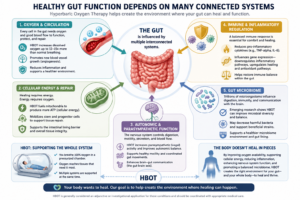
For many people, chronic digestive problems aren’t caused by one simple issue. The gut is an incredibly complex system influenced by circulation, oxygen availability, inflammation, neurological signaling, intestinal motility, immune function, and the trillions of microorganisms that make up the gut microbiome.
When one or more of these systems become disrupted, normal digestive function can become disrupted as well.
This raises an interesting question:
Instead of focusing only on the symptoms of poor digestion, what if we also worked to improve the environment in which healthy gut function is supposed to occur?
That is where hyperbaric oxygen therapy becomes interesting.
Research specifically studying HBOT for conditions such as IBS, SIBO, and chronic constipation is still limited. We therefore cannot say that HBOT is a proven treatment for these conditions.
But we do know quite a bit about the physiology behind many chronic digestive problems — and we are beginning to understand how HBOT influences some of those same systems. Clinically, we also frequently see patients report positive changes in digestive function during treatment.
The Gut Doesn’t Work Alone
We often think about digestion as something that happens exclusively inside the stomach and intestines.
It doesn’t.
Healthy digestion requires communication between the brain, autonomic nervous system, enteric nervous system, immune system, circulation, intestinal lining, and gut microbiome.
IBS itself is now considered a disorder of gut-brain interaction. Altered intestinal motility, visceral sensitivity, immune activation, intestinal permeability, microbiome changes, and abnormal communication between the brain and gut can all contribute to symptoms.
SIBO is different, but motility is also extremely important. The small intestine has natural sweeping contractions that help move material and bacteria through the digestive tract. When these mechanisms become impaired, bacteria may be more likely to accumulate where they don’t belong.
Constipation can likewise involve altered motility and neurological dysregulation.
So while these conditions are different, several important systems overlap.
And HBOT may influence several of them simultaneously.
1. Change the Environment
Every cell in the gastrointestinal tract requires oxygen.
Oxygen is necessary for mitochondrial energy production, maintenance of the intestinal barrier, immune regulation, circulation, and tissue repair.
During HBOT, you breathe 100% oxygen inside a pressurized medical chamber. The increased pressure dramatically increases the amount of oxygen carried within the blood plasma, allowing oxygen to reach tissues at concentrations that cannot be achieved by breathing oxygen at normal atmospheric pressure.
HBOT can also influence inflammatory signaling and stimulate the growth of new small blood vessels through angiogenesis.
This doesn’t mean that every person with IBS or constipation has an oxygen deficiency in their intestine.
It means that oxygen availability, cellular energy, circulation, and inflammation are fundamental parts of the biological environment in which the gastrointestinal system has to function.
HBOT changes that environment.
2. Give the Gut the Energy and Resources It Needs
The intestinal lining is one of the most metabolically active and rapidly renewing tissues in the body.
Those cells require energy.
And cellular energy production requires oxygen.
Healing requires energy. And energy requires oxygen.
By dramatically increasing oxygen availability, HBOT provides cells with one of the fundamental resources required for mitochondrial energy production, maintenance, and repair.
HBOT has also been shown to mobilize circulating stem and progenitor cells involved in tissue repair and blood-vessel formation.
Again, this doesn’t mean HBOT directly “treats IBS” or “cures SIBO.”
It means we are improving several of the biological resources the body relies upon to maintain and repair healthy tissue.
3. Support the Nervous System That Controls the Gut
This may be one of the most overlooked parts of digestive health.
Your gut is neurologically controlled.
The autonomic nervous system continuously influences intestinal motility, secretion, blood flow, digestive activity, and communication between the brain and gastrointestinal tract.
One particularly important component is the parasympathetic nervous system, including the vagus nerve.
Parasympathetic activity is associated with the body’s “rest and digest” functions and plays an important role in normal gastrointestinal activity. Research has demonstrated that hyperbaric oxygen can significantly increase parasympathetic influence on autonomic function.
Why might that matter?
Because digestion isn’t simply a chemical process. Your intestines need coordinated neurological signals to move their contents appropriately.
Healthy intestinal motility helps move food, waste products, and microorganisms through the digestive tract. When motility becomes impaired, intestinal contents can remain stagnant for longer periods, potentially contributing to constipation and creating an environment that may favor bacterial overgrowth in susceptible individuals.
Therefore, if HBOT supports parasympathetic and autonomic function, it is reasonable from a physiological standpoint to ask whether those neurological changes may also support healthier digestive function.
This is an area where more direct clinical research is needed, but it is also something we frequently observe clinically: as autonomic function improves, many patients report improvements in digestion and bowel function as well.
4. The Gut Microbiome May Respond Too
Perhaps one of the most fascinating emerging areas of HBOT research involves the gut microbiome.
The microorganisms living within our gastrointestinal tract influence digestion, immune function, intestinal barrier integrity, inflammation, metabolism, and even communication between the gut and brain.
Microbiome disturbances, or dysbiosis, have been associated with numerous gastrointestinal disorders, including IBS, SIBO, and inflammatory bowel disease.
Recent human research in Crohn’s disease has demonstrated that HBOT can alter the intestinal microbiome.
Following HBOT, researchers observed increased microbial diversity, decreases in Escherichia, and increases in bacteria including Bifidobacterium. These changes occurred alongside reductions in inflammatory markers and Crohn’s disease activity.
This does not prove that HBOT corrects dysbiosis in IBS or eliminates SIBO. Clinically, however, we have seen patients with SIBO improve when hyperbaric oxygen therapy is combined with neurological rehabilitation aimed at improving autonomic and gastrointestinal function.
But the research demonstrates something important:
Changing the oxygen and inflammatory environment of the body can change the microbial environment of the gut.
That opens an entirely new area of research into how HBOT may influence gastrointestinal health.
5. The Gut-Brain Connection Works Both Ways
The relationship between the brain and gut is not one-directional.
The brain influences digestion, but the gut also continually sends information back to the brain through neurological, immune, hormonal, and metabolic pathways.
This is the gut-brain axis.
Stress can change digestion. Autonomic dysfunction can change motility. Changes in the microbiome can influence immune and neurological signaling. Intestinal inflammation can alter how the nervous system behaves.
Everything is connected.
This is why treating chronic digestive symptoms by looking at only one piece of the system can sometimes be challenging.
What About IBS, SIBO, and Constipation?
Although HBOT is not yet a firmly established treatment for IBS, SIBO, or chronic constipation due to limited condition-specific research, limited research doesn’t mean HBOT cannot help. It means we don’t yet have enough clinical studies to tell us exactly how much it may help, which patients are most likely to respond, or what treatment protocols may be most effective.
At the same time, there is a strong physiological rationale for using HBOT as an adjunctive therapy in these populations. We understand many of the underlying systems that contribute to healthy digestive function, and we understand many of the physiological effects HBOT has on those same systems. From a neurological and physiological perspective, the connection between the two makes sense — and clinically, we frequently see meaningful improvements in digestive function in our patients.
We already know HBOT can:
- substantially increase tissue oxygen availability
- influence inflammatory signaling
- support mitochondrial energy production
- stimulate angiogenesis
- mobilize stem and progenitor cells
- increase parasympathetic influence
- and, in early human research, alter the gut microbiome
We also know that many chronic gastrointestinal disorders involve disturbances in some combination of motility, autonomic regulation, inflammation, microbiome composition, intestinal barrier function, and brain-gut communication.
This is where the connection becomes important.
The same physiological systems that can become disrupted in chronic digestive dysfunction are systems that HBOT has been shown to influence.
That doesn’t mean that because HBOT increases parasympathetic activity, it therefore cures constipation. And it doesn’t mean that because HBOT has been shown to change the microbiome in Crohn’s disease, it therefore eliminates SIBO.
It means something broader:
HBOT influences several of the fundamental systems required for healthy gastrointestinal function. While more condition-specific research is needed, there is a strong physiological rationale for why improving those systems may help people struggling with chronic digestive dysfunction.
And that is exactly what we are trying to accomplish — not simply chase digestive symptoms, but create a healthier environment in which the gut and the systems controlling it can function the way they are supposed to.
The Body Doesn’t Heal in Pieces
The gut is not simply a tube that digests food.
It is neurological. It is vascular. It is metabolic. It is immunological. It is microbial. And above all, it is interconnected.
All of those systems communicate with and influence one another.
That is why we believe one of the most interesting aspects of hyperbaric oxygen therapy is that it doesn’t target only one symptom or pathway.
It changes the environment.
HBOT increases oxygen availability, supports cellular energy production, influences inflammation and circulation, supports autonomic regulation, activates the body’s own repair mechanisms, and may influence the microbial environment of the intestine.
The body doesn’t heal in pieces — and we shouldn’t think about gut health in pieces either.
For someone struggling with chronic digestive dysfunction, that doesn’t guarantee that HBOT will resolve their symptoms.
But it gives us a very different question to ask:
What happens when we improve the environment in which the gut is trying to function?
Because ultimately, your body wants to heal. Our goal is to help create the environment where healing can happen.
Research specifically evaluating HBOT for IBS, SIBO, and functional constipation remains limited. HBOT should not replace appropriate evaluation or established medical treatment for gastrointestinal disease.