Crohn’s disease and ulcerative colitis are inflammatory bowel diseases that can be incredibly difficult to manage. While medications, nutrition, biologic therapies, and surgery remain important parts of treatment, researchers are increasingly looking at another part of the healing equation: the environment within the damaged intestinal tissue itself.
One of the challenges with chronic intestinal inflammation is that it can interfere with blood flow and oxygen delivery. As inflammation increases, the intestinal tissue can become relatively hypoxic — meaning it isn’t receiving enough oxygen to function and repair normally.
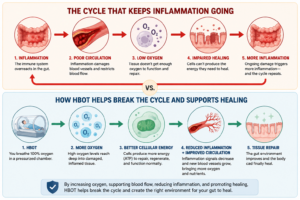
This can create a difficult cycle:
Inflammation → impaired circulation → lower oxygen → impaired healing → continued inflammation.
Hyperbaric oxygen therapy (HBOT) changes that environment.
Why Oxygen Matters to the Gut
Every cell in the intestinal wall requires oxygen to produce energy, maintain its protective barrier, regulate immune activity, and repair damaged tissue.
During HBOT, you breathe 100% oxygen while inside a pressurized medical chamber. The increased pressure allows significantly more oxygen to dissolve directly into the plasma and other body fluids, allowing oxygen to reach areas where normal circulation may be compromised.
For inflamed intestinal tissue, that increased oxygen availability may support several important healing processes at the same time.
1. Reducing Inflammation
Inflammatory bowel disease involves an overactive inflammatory response within the intestinal wall. Research suggests HBOT can influence inflammatory signaling, including reductions in inflammatory mediators such as TNF-alpha and IL-6. It also reduces inflammation at the genetic level, inhibiting pro-inflammatory genetic expression and activation anti-inflammatory pathways, altering gene expression.
Rather than simply thinking about HBOT as “giving the body more oxygen,” it may be more helpful to think of oxygen as a signal that can influence how cells respond to inflammation and injury.
2. Restoring Oxygen to Hypoxic Tissue
Damaged and inflamed intestinal tissue can become poorly oxygenated. Unfortunately, the cells responsible for repairing that tissue also require significant amounts of energy — and therefore oxygen — to do their work. Without it, they cannot heal, but Hyperbaric Oxygen therapy produces the environment that provides abundant amounts of oxygen for these cells to heal and thrive.
HBOT dramatically increases the amount of oxygen available to tissues, potentially helping cells produce the energy necessary for repair.
Healing requires energy. And energy requires oxygen.
3. Supporting New Blood Vessel Formation
Healing is not only about getting more oxygen into tissue today. The body also needs to rebuild its ability to deliver oxygen tomorrow.
HBOT can stimulate angiogenesis — the formation of new small blood vessels. Over time, improved microcirculation may help create a healthier environment for damaged intestinal tissue to repair and maintain itself without the need for constant treatments.
4. Supporting Difficult-to-Heal Fistulas
One particularly interesting area of HBOT research involves fistulizing Crohn’s disease, especially difficult perianal fistulas that have not responded adequately to conventional treatment.
Fistulas are complex wounds, and chronic inflammation, infection, and poor tissue oxygenation can make them extremely difficult to heal.
By increasing tissue oxygenation while supporting blood vessel growth and wound repair, HBOT may provide another tool alongside established medical and surgical treatment to restore tissue health.
5. The Gut Microbiome May Also Respond
One of the newest areas of research is the relationship between HBOT and the gut microbiome.
A 2024 study in patients with Crohn’s disease found changes in microbial diversity and composition following HBOT, including decreases in Escherichia and increases in bacteria such as Bifidobacterium. Researchers also observed reductions in inflammatory markers and Crohn’s disease activity.
This research is still early, but it raises an interesting possibility: changing the oxygen and inflammatory environment of the intestine may also influence the ecosystem of microorganisms living within it.
6. Mobilizing the Body’s Own Repair Cells – Stem Cells
Another fascinating effect of HBOT is its ability to stimulate the body’s own repair mechanisms.
Human studies have demonstrated significant increases in circulating stem/progenitor cells following a series of hyperbaric treatments, with one frequently cited study reporting an approximately eight-fold increase after 20 treatments.
These cells are involved in blood-vessel formation and tissue repair throughout the body. While more research is needed to determine their specific contribution to inflammatory bowel disease, stem and progenitor cell mobilization provides another potential mechanism through which HBOT may support the body’s natural healing response.
7. Supporting the Brain-Gut Connection and Autonomic Function
The gut doesn’t function independently — it is under constant neurological control.
The autonomic nervous system, particularly the parasympathetic nervous system and vagus nerve, plays an important role in healthy digestion, intestinal motility, blood flow, secretion, and communication between the brain and gut.
Research has demonstrated that hyperbaric oxygen can significantly increase parasympathetic activity. This is important because improving parasympathetic function may help create a healthier neurological environment for normal digestion, intestinal motility, and brain-gut communication.
When motility is impaired, intestinal contents can remain stagnant for longer periods of time, potentially contributing to an unhealthy gastrointestinal environment. Supporting healthy autonomic regulation and motility therefore represents another way HBOT may support overall gut function.
This is something we also observe clinically: as autonomic function improves, patients frequently report improvements in digestive function alongside improvements in other autonomic symptoms.
The gut isn’t just a digestive organ. It is part of a complex neurological system, constantly communicating with the brain through the brain-gut axis. Supporting that communication may be an important part of restoring healthier gut function.
What Does the Research Show?
Research into HBOT for inflammatory bowel disease continues to grow, with studies examining both Crohn’s disease and ulcerative colitis.
Systematic reviews have reported encouraging clinical responses when HBOT is used alongside conventional treatment. Research into fistulizing Crohn’s disease has also shown promising results, including improvement in difficult perianal fistulas.
More recently, researchers have studied HBOT in patients with moderate-to-severe, treatment-resistant ulcerative colitis, looking not only at symptoms but also at intestinal healing, inflammation, and bowel perfusion.
These findings are promising, but HBOT is not currently a replacement for standard Crohn’s disease or ulcerative colitis treatment. Much of the research has involved patients with severe or treatment-resistant disease, and larger randomized clinical trials are still needed.
We view HBOT as a potential adjunct — another way to support the biological environment in which healing needs to occur.
The Body Doesn’t Heal in Pieces
The intestine isn’t isolated from the rest of the body. It depends on circulation, oxygen delivery, immune regulation, cellular energy production, neurological control and signaling, and the trillions of microorganisms that make up the gut microbiome.
That is why HBOT is fundamentally different from therapies directed at one particular symptom or pathway.
It changes the environment, not only to the injured area, but to the entire body and the systems required for healing and healthy function.
By increasing oxygen availability, supporting microcirculation, regulating inflammatory pathways, stimulating new blood vessel formation, improving brain-gut connections, and potentially influencing the microbiome, HBOT may help provide damaged intestinal tissue with more of what it needs to repair itself.
Because ultimately, your body wants to heal. Our goal is to help create the environment where healing can happen.
Hyperbaric oxygen therapy for Crohn’s disease and ulcerative colitis is generally considered an adjunctive or investigational application and should be coordinated with appropriate medical and gastroenterology care.