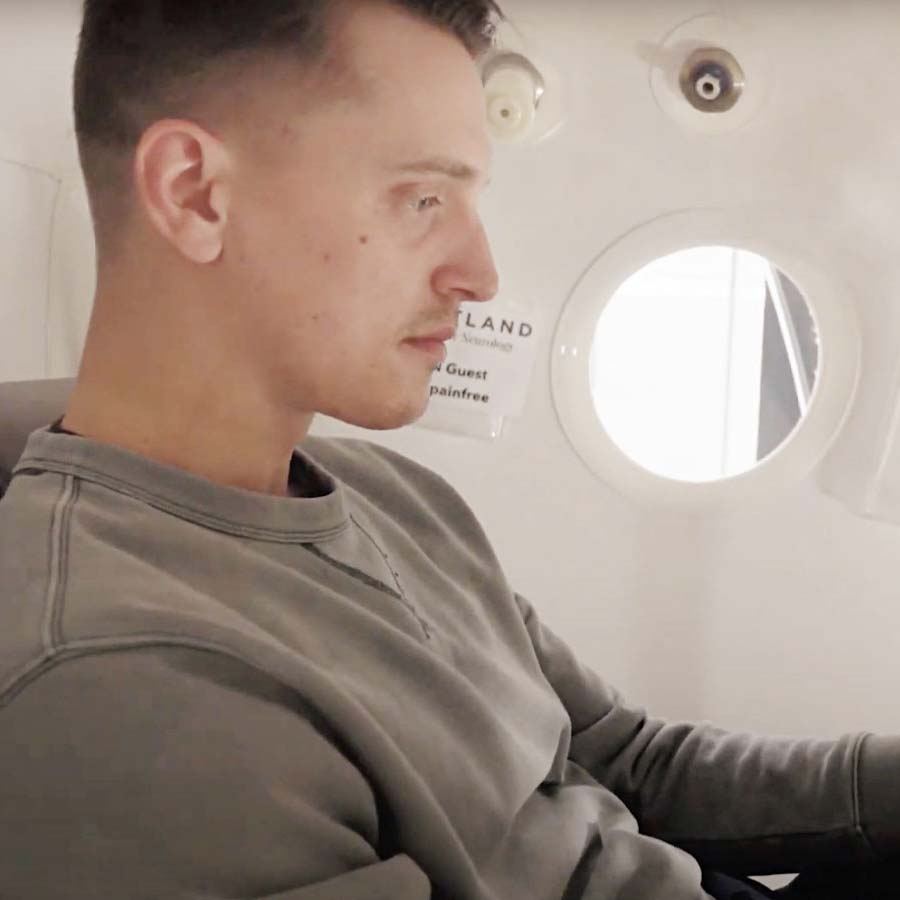
Some of the most common symptoms we hear from our patients after concussion are brain fog and overwhelming fatigue. Before the injury, they could work all day, exercise, drive, read, spend time on their phone, or go out with friends without thinking twice about it. After a concussion, those same activities can leave them exhausted, foggy, dizzy, spacey, or needing to lie down.
Why?
Because a concussion creates damage and dysfunction within the brain itself, disrupting brain cells and their connections, altering neurological signaling, and affecting normal blood flow and energy metabolism within the brain. Repairing that damage requires an incredible amount of energy. And producing that energy requires oxygen. This is where Hyperbaric Oxygen Therapy comes in.
Our brain is already incredibly energy hungry. Although it makes up only about 2% of our body weight, it consumes roughly 20% of the body’s oxygen at rest. That oxygen is used by our mitochondria to produce ATP—the cellular energy that allows neurons to communicate, maintain their electrical balance, process information, and ultimately keep our brain and body functioning normally.
After a concussion, the brain suddenly needs even more energy to restore normal function and repair itself, yet the injury can simultaneously interfere with its ability to produce that energy efficiently. This creates what researchers have long described as the neurometabolic energy crisis of concussion—and it’s one of the reasons Hyperbaric Oxygen Therapy is so helpful for brain recovery.
HBOT uses increased atmospheric pressure combined with high concentrations of oxygen to dramatically increase the amount of oxygen carried within the bloodstream and delivered into tissues. By increasing oxygen availability, we are providing one of the fundamental ingredients our mitochondria require to produce the energy needed for normal brain function and repair.
But to understand why this is so important, we first have to understand what happens inside the brain after a concussion.
What Happens to the Brain During a Concussion?
When the head rapidly accelerates and decelerates, the brain moves and deforms within the skull. This mechanical force can stretch neurons, their long connections called axons, and the membranes surrounding our brain cells.
That initial mechanical injury triggers a cascade of events:
- Potassium rapidly moves out of neurons.
- Sodium and calcium move into the cells.
- Large amounts of neurotransmitters are released.
- Neurons become abnormally activated.
- The brain must now work extremely hard to restore its normal electrical balance.
- Mitochondria are placed under increased metabolic stress at exactly the time they are being asked to produce more energy.
The pumps within our neuronal membranes—particularly the sodium-potassium pumps—begin working overtime to restore the electrical gradients necessary for neurons to communicate normally. These pumps require ATP, meaning the injured brain suddenly has a significantly increased demand for cellular energy.
Research by Giza and Hovda helped establish this neurometabolic cascade of concussion, and decades of subsequent research have continued to expand our understanding of it. We now know that concussion can affect much more than neurons themselves, influencing mitochondrial function, cerebral blood flow, inflammation, blood vessels, neural networks, and broader physiological systems throughout the brain and body.
And this is where the problem compounds.
The brain needs more energy to recover, but the injury itself can interfere with its ability to produce and deliver that energy.
Changes in cerebral blood flow can alter the delivery of oxygen and glucose. Mitochondrial dysfunction can make cellular energy production less efficient. Calcium accumulation can further stress the mitochondria, while inflammation creates additional metabolic demands.
The brain is essentially trying to repair itself while operating with an energy deficit.
Why Does Everything Feel So Much Harder?
This helps explain something we hear from patients all the time:
“I can still do it. I just can’t do it for very long.”
Reading may have been effortless before your concussion, but reading is actually an incredibly complicated neurological task. Your eyes have to move accurately across the page, your visual system has to process the words, your brain has to maintain attention, interpret language, access memory, filter irrelevant information, and integrate all of this while maintaining stable vision and awareness of your surroundings.
Driving requires even more—simultaneously processing movement, speed, depth, peripheral vision, eye movements, head movements, balance, spatial awareness, attention, decision-making, and autonomic regulation.
A healthy brain handles these tasks so efficiently that we rarely appreciate how much work is occurring behind the scenes. But after concussion, the same neurological task may require substantially more effort from a system that has fewer resources available.
This helps explain why relatively normal activities can suddenly produce brain fog, headaches, dizziness, visual fatigue, difficulty concentrating, irritability, exercise intolerance, or overwhelming physical and cognitive fatigue.
The brain may still be able to perform many of these tasks, but with reduced neurological and metabolic endurance, doing them for too long can quickly bring symptoms back.
Oxygen, Energy, and Brain Healing
This is where we come back to oxygen.
Healing requires energy. Energy production requires oxygen. Low oxygen availability means less energy available for healing.
The brain has a remarkable ability to repair, strengthen, and reorganize its neurological connections through neuroplasticity. But repairing cell membranes, restoring normal ion gradients, maintaining synapses, producing proteins, growing blood vessels, remodeling neural networks, and creating new connections all require cellular energy—and ultimately, oxygen.
Hyperbaric Oxygen Therapy allows us to substantially increase oxygen availability during this period of increased metabolic demand. Under pressure, oxygen dissolves directly into the plasma—the liquid portion of our blood—allowing dramatically more oxygen to circulate throughout the body and diffuse into tissues.
But HBOT isn’t simply about giving the brain more oxygen during a treatment.
Repeated hyperbaric oxygen exposures have been shown to influence several processes involved in neurological repair, including:
- increasing tissue oxygen availability
- supporting mitochondrial energy production and cellular metabolism
- reducing inflammatory signaling
- stimulating angiogenesis—the growth and repair of blood vessels
- mobilizing stem and progenitor cells
- supporting neuroplasticity and regenerative signaling
- improving circulation and oxygen delivery to tissues
This is important because the goal isn’t simply to provide oxygen today. Angiogenesis may help improve the vascular network responsible for delivering oxygen and nutrients into the future, while neuroplasticity allows the brain to strengthen and reorganize the neurological networks required for healthier function.
Research using advanced brain imaging has demonstrated changes in cerebral blood flow and brain microstructure following HBOT in people with persistent symptoms after traumatic brain injury, with these changes correlating with improvements in cognitive function. Research has also demonstrated HBOT-related angiogenesis and regeneration of nerve fibers in patients with chronic traumatic brain injury.
Creating the Environment for the Brain to Heal
This is ultimately why Hyperbaric Oxygen Therapy can be such a powerful tool for supporting brain healing after concussion and more severe traumatic brain injuries.
The goal isn’t to force the brain to heal. The brain already knows how to heal. Our goal is to help create the biological environment where those healing processes can occur more effectively.
After concussion, the brain may need tremendous amounts of energy for repair at exactly the time that blood flow, oxygen delivery, mitochondrial function, and cellular metabolism may be compromised.
HBOT helps change that environment by substantially increasing oxygen availability while supporting many of the processes the brain relies upon for longer-term recovery—including cellular energy production, circulation, angiogenesis, inflammatory regulation, and neuroplasticity.
The brain wants to heal. Healing requires energy. Energy requires oxygen.
Sometimes giving the brain more of what it needs creates a better environment for it to do what it already knows how to do.
Research
Giza CC, Hovda DA. The Neurometabolic Cascade of Concussion. Journal of Athletic Training. 2001.
Giza CC, Hovda DA. The New Neurometabolic Cascade of Concussion. Neurosurgery. 2014.
Flavin WP, Bickart KC, Le Belle JE, et al. Evolution of the Neurometabolic Cascade of Traumatic Brain Injury.Neurologic Clinics. 2026.
Tal S, Hadanny A, Sasson E, Suzin G, Efrati S. Hyperbaric Oxygen Therapy Can Induce Angiogenesis and Regeneration of Nerve Fibers in Traumatic Brain Injury Patients. Frontiers in Human Neuroscience. 2017.
Thom SR, Bhopale VM, Velazquez OC, et al. Stem Cell Mobilization by Hyperbaric Oxygen. American Journal of Physiology—Heart and Circulatory Physiology. 2006.