Our brain is incredibly complex, consisting of approximately 100 billion brain cells called neurons and more than 100 trillion connections between them called synapses. These synaptic connections allow information to travel throughout the brain, coordinating and facilitating virtually every neurological and bodily function. Without these connections, the brain simply cannot function.
Generally speaking, a healthy brain isn’t just about the number of neurons we have—it’s about how effectively those neurons connect and communicate with one another. As we develop, learn, move, experience the world, and challenge our brains, these connections are continually strengthened, weakened, reorganized, and created.
This ability to change is fundamental to how the brain develops—and it is also fundamental to how the brain heals.
When the brain is injured or altered through concussion or traumatic brain injury, Lyme and other co-infections, Long-covid and other viral impacts, inflammation, vascular injury, depression/PTSD, Migraines or other neurological stressors, neurons and their connections can become damaged, often creating compensations that result in symptoms and altered function. Blood flow and oxygen delivery may also become disrupted, inflammation can increase, and the mitochondria responsible for producing cellular energy may not function as efficiently.
The result is a brain that has to work harder while having fewer resources available to do it.
Depending upon which neurological networks are affected, this can contribute to symptoms such as headaches, migraines, visual tracking problems, dizziness, imbalance, spatial disorientation, brain fog, fatigue, POTS/dysautonomia, poor coordination, tremors, cognitive changes, and more.
But here’s the great news:
The brain can heal.
The brain has the remarkable ability to repair and strengthen existing connections and create new pathways when necessary through a process called neuroplasticity. This is one of our brain’s fundamental mechanisms for adapting and recovering after injury.
But neuroplasticity has a requirement.
Healing requires energy.
And the brain requires an extraordinary amount of it.
Although the brain represents only about 2% of our body weight, it consumes approximately 20% of the body’s oxygen at rest. That oxygen is essential for producing ATP—the cellular energy that neurons need to maintain their electrical activity, communicate with one another, maintain synapses, and support the processes involved in repair and recovery.
After a brain injury, the need for repair increases at the same time that the brain’s ability to produce and deliver energy may be compromised.
This is one of the challenges following traumatic brain injury. Changes in cerebral blood flow, inflammation, mitochondrial dysfunction, and impaired oxygen utilization can contribute to what is often described as a neurometabolic energy crisis. Research has demonstrated that decreased cerebral blood flow and oxygen delivery after TBI can impair efficient aerobic energy production precisely when injured brain tissue needs energy for recovery.
It’s a difficult combination:
The brain needs energy to heal, but the injury itself can interfere with its ability to produce that energy.
Where Hyperbaric Oxygen Therapy Comes In
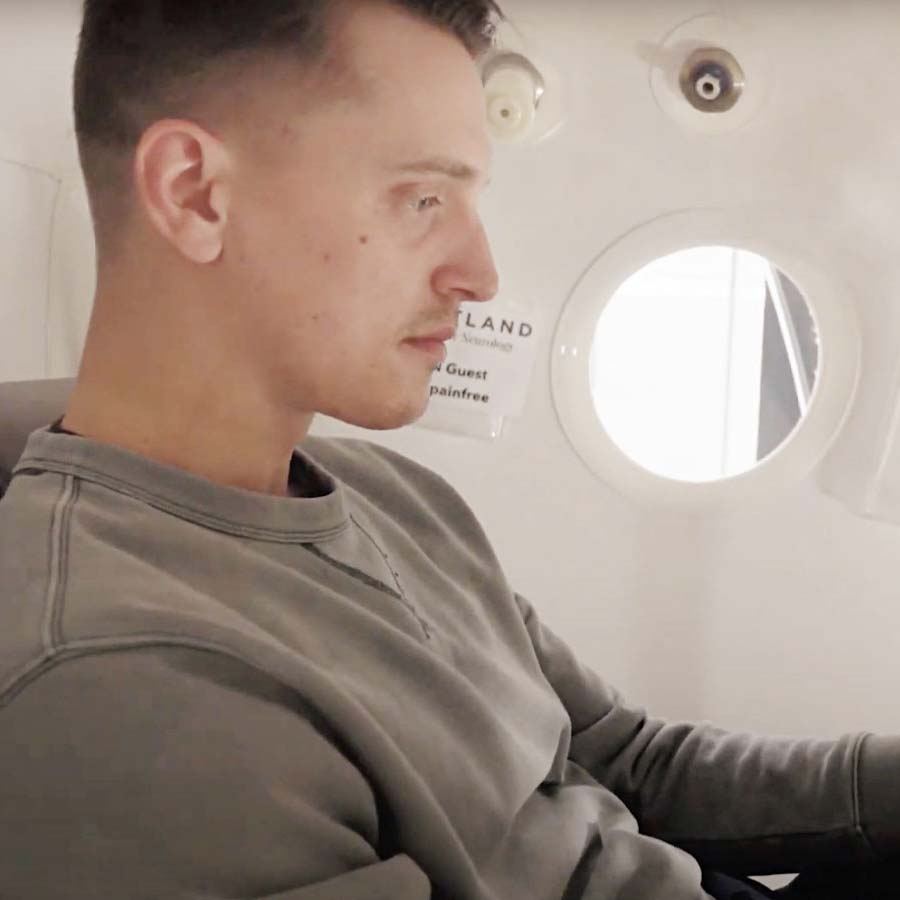
Hyperbaric Oxygen Therapy can dramatically change the amount of oxygen available to injured tissue.
By combining increased atmospheric pressure with high concentrations of oxygen, HBOT significantly increases oxygen carried within the plasma, allowing oxygen to reach areas where normal circulation and oxygen delivery may be compromised.
But providing oxygen is only part of what makes HBOT so interesting for brain health.
Research suggests that HBOT can influence several biological processes involved in neurological recovery, including improving tissue oxygenation and cellular metabolism, reducing inflammatory signaling, stimulating angiogenesis and neurogenesis, and supporting neuroplasticity.
Human brain-imaging research in patients with persistent symptoms following traumatic brain injury has demonstrated increased cerebral blood flow following HBOT along with measurable changes in white- and gray-matter microstructure. Importantly, those changes correlated with improvements in memory, executive function, information-processing speed, and overall cognitive performance.
HBOT may also help address one of the longer-term problems following brain injury: getting blood and oxygen back to the areas that need it. Through angiogenesis—the growth and repair of blood vessels—HBOT may help improve the vascular network supplying previously compromised brain tissue.
There is also evidence that hyperbaric oxygen can influence the autonomic nervous system. Human research has demonstrated a significant increase in parasympathetic activity during hyperbaric oxygen exposure, which is particularly interesting when considering the importance of autonomic regulation in circulation, recovery, and overall neurological function.
Creating the Environment for the Brain to Heal
This is ultimately how we think about Hyperbaric Oxygen Therapy.
HBOT doesn’t replace the brain’s ability to heal. It helps create the environment where healing can happen.
The brain already possesses an extraordinary capacity for neuroplasticity and repair. But those processes require tremendous amounts of energy and the proper biological environment to occur.
Hyperbaric Oxygen Therapy provides substantially more oxygen for cellular energy production while simultaneously supporting many of the processes involved in neurological recovery—including circulation, angiogenesis, neuroplasticity, cellular metabolism, autonomic regulation, and inflammatory control.
The brain wants to heal.
Sometimes it simply needs more of the resources required to do it.